In a previous article, I have already investigated the effect of coffee on our body, but this is not all that we need to know when we decide how much coffee we drink, but the sustainability of the regular consumption. The coffee market is a pioneer in getting sustainable voluntarily. On the other hand, coffee production is still far from perfect as many studies show that existing certifications don’t reach the outcomes they meant to reach. Therefore, collaborations are emerging like Sustainable Coffee Challenge to include all participants in the coffee market (even us, costumers) in creating a more sustainable future for coffee as the demand for coffee is continuously growing.
Coffee is the most beloved beverage in the world, as people are consuming 145 million bags a year on average.
Although, we also need to consider if this high consumption of coffee is sustainable in the long run. Many measures need to be taken to determine the sustainability of the product by identifying the hotspots in the supply chain. These hotspots can appear in farming, roasting, delivering and even at packaging the products. On the other hand, the most critical state with most of the risk factors is farming. Risk factors involve social factors like child labour, labour rights, worker health and safety, environmental factors like deforestation, biodiversity and water scarcity. Therefore, it is essential to look at the circumstances of the coffee-producing countries.
Top coffee producers
Coffee is grown in tropical regions of the world with the top three coffee producing countries being Brasilia, Vietnam and Colombia. Many of the people love the flavourful arabica beans which dominate the middle and high end of the coffee market. The majority of the arabica is produced in Brasilia followed by Colombia and Ethiopia. On the other hand, Robusta, which survives in more varied conditions, is likely used in cheaper coffee blends and instant coffee. The majority of Robusta on the market is grown in Vietnam followed by Brasilia and Indonesia (1).
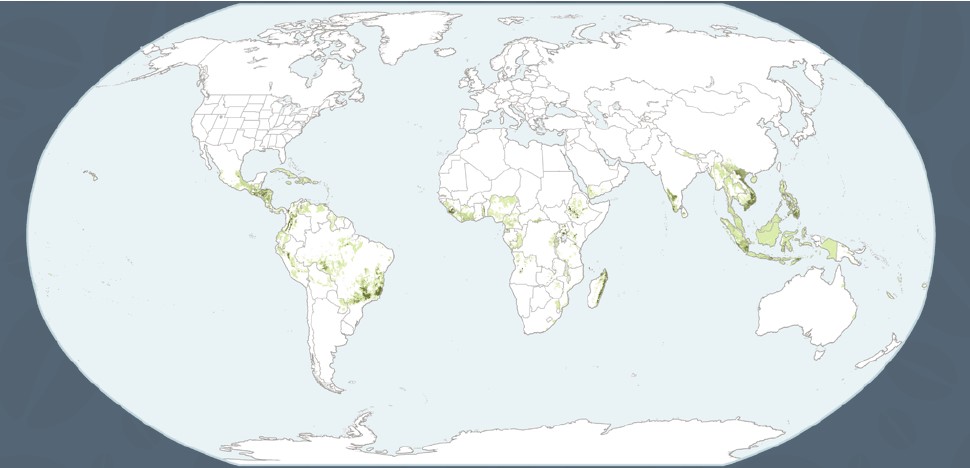
Source: The Sustainability Consortium. 2017. Coffee production and sustainability, The Sustainability Consortium’s commodity mapping report
Hotspots
The Sustainability Consortium published a report which identifies the sustainability risks in different coffee farming regions. First, let’s look at the main producers of Arabica as it is ruling the market. As I mentioned before the top three are Brasilia, Colombia and Ethiopia.
Among Arabica producers they identified Ethiopia having the lowest environmental risk, only showing high risk for biodiversity.
Unfortunately, coffee production means high risk for biodiversity everywhere, but both Brasilia and Columbia have a greater risk for deforestation and Columbia even has a high risk for child labour (1).
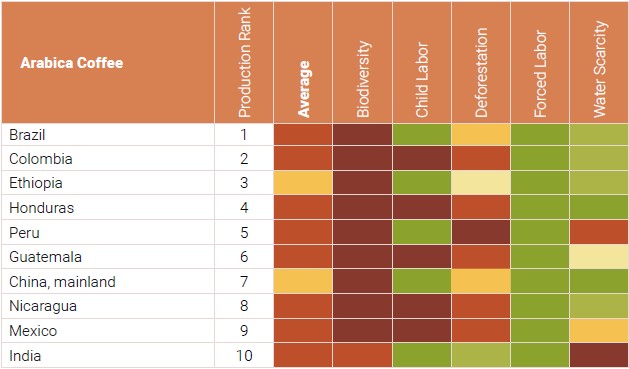
Source: The Sustainability Consortium. 2017. Coffee production and sustainability, The Sustainability Consortium’s commodity mapping report
If we take a look at Robusta, unfortunately, the greatest producer carries the greatest environmental and social risks. Vietnam has some risk for water scarcity, high risk both for biodiversity, deforestation and child labour compared to Brazil and Indonesia where there is no risk for child labour and water scarcity. Indonesia has a high risk for deforestation too.
In conclusion, Brasilia finishes on the first place in the race for sustainability among the major Robusta Producers (1).
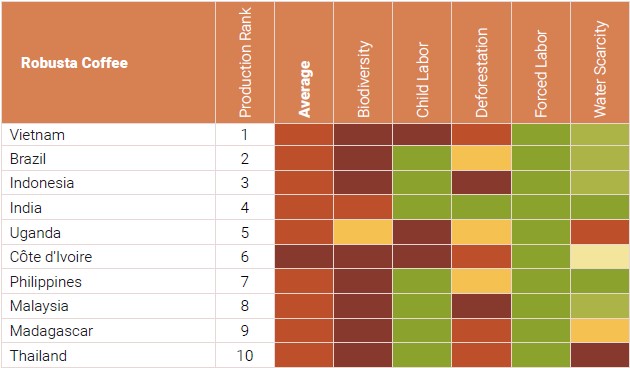
Source: The Sustainability Consortium. 2017. Coffee production and sustainability, The Sustainability Consortium’s commodity mapping report
Coffee as biodiversity risk
This data indicates that biodiversity is at risk in all of the coffee-producing regions. This has a very simple reason, territoriality. The coffee plant has very specific needs, especially the arabica species. It only grows in tropical regions in very special circumstances which are also the region of exceptional biodiversity and a selection of plants, which can be found nowhere else. Unfortunately, agriculture and monocultures taking the place away from these plants (2) (3).
Governance of sustainability
We can see that the coffee market still struggles from sustainability problems, although it has historically been a pioneer in sustainability efforts. On the other hand, how do they monitor sustainability throughout the supply chain? Numerous certification schemes have emerged in the early 2000s, which intend to improve the environmental and social sustainability of production. Although as the coffee market is highly international it is difficult to regulate it through governments, so the organisations in the supply chain developed voluntary regulations through their interaction with each other. Unfortunately, these regulations are not working the best yet as it does not address the environmental and social problems for what it was created well enough. Therefore, there are emerging direct-impact projects which are very promising as they include the companies’ interpretation and priorities in addressing sustainability in collaboration.
An example of these efforts is the Sustainable Coffee Challenge. This allows creating a market which is sustainable both environmentally, socially and economically. (3)
What can WE do?
What consumers can do is look for coffee certifications when buying a product, as these certifications ensure that sustainability was concerned throughout processing. Widespread coffee certifications are eg.: Rainforest Alliance, Fair Trade, UTZ, 4 common code and Organic. (1) By buying these products you can pressure farmers to meet the requirements of the certifications otherwise they lose significant income.
But this is not the only way!
You can get involved in this conversation yourself by asking in the café where you get your daily brew if they know where their coffee comes from and encourage them to research their sources.
In the framework of Sustainable Coffee Challenge, a section wide collaboration came to life to ensure the coffee supply even though climate change will mean a hard time for farmers. They also encourage everyone to participate in this conversation and act to help maintain their coffee in the future.
1 The Sustainability Consortium. 2017. Coffee production and sustainability, The Sustainability Consortium’s commodity mapping report
2 https://databasin.org/datasets/23fb5da1586141109fa6f8d45de0a260
3 https://databasin.org/datasets/a5b34649cc69417ba52ac8e2dce34c3b 4 the rise of buyer driven sustainability governance: emerging trends in the global coffee sector
 Foodaware
Great post!